Casting Spells
A rule of the game.
Spells are the main way Avatars and other Spellcasters influence the realm. You cast minions, artifacts, auras, and magics. You can only cast a spell during your main phase, while the storyline is empty. (A few cards like Dodge Roll grant a timing exception.) When you cast a spell, follow this process: 1. Choose the Spellcaster. 2. This is often your Avatar, but it can be any Spellcaster you control. 3. If your Spellcaster occupies multiple locations, choose the location where they're casting the spell. For example, River of Flame occupies two locations, surface and subsurface; when it casts a spell, you must choose if it's casting from the surface or subsurface location. 4. Reveal the spell and confirm you have the necessary threshold and mana to cast it. Note: Both players are responsible for confirming that all spells are cast legally! The most common spellcasting mistake is having insufficient threshold. Make it a regular practice to check threshold on every spell that's cast! 5. Choose additional details based on the type of spell. See ))below((. Once you've done those three steps, you actually pay the cost to cast the spell and the card moves from where it was (usually your hand) and enters the storyline. It will then resolve according to the normal storyline rules.Feitiços são a principal forma de Avatares e outros Conjuradores influenciarem o reino. Você conjura lacaios, artefatos, auras e magias. Você só pode conjurar um feitiço durante a sua fase principal, enquanto o enredo estiver vazio. (Algumas cartas como Dodge Roll concedem exceção de tempo.) Ao conjurar um feitiço, siga este processo: 1. Escolha o Conjurador. 2. Frequentemente é o seu Avatar, mas pode ser qualquer Conjurador que você controle. 3. Se o seu Conjurador ocupar múltiplas localizações, escolha a localização de onde ele está conjurando o feitiço. Por exemplo, River of Flame ocupa duas localizações, superfície e subsuperfície; ao conjurar um feitiço, você deve escolher se está conjurando da localização de superfície ou de subsuperfície. 4. Revele o feitiço e confirme que você tem o limiar e o mana necessários para conjurá-lo. Nota: ambos os jogadores são responsáveis por confirmar que todos os feitiços são conjurados legalmente! O erro de conjuração mais comum é ter limiar insuficiente. Faça da checagem de limiar uma prática regular em todo feitiço conjurado! 5. Escolha detalhes adicionais conforme o tipo de feitiço. Veja ))abaixo((. Uma vez feitos esses três passos, você de fato paga o custo para conjurar o feitiço e a carta sai de onde estava (normalmente sua mão) e entra no enredo. Ela então resolve segundo as regras normais de enredo.Unofficial translation
Casting Minions
To cast a minion spell, you must declare the minion's summoning location. By default, you must choose the surface of one of your sites. Some abilities may modify what summoning locations you may choose. For example, minions with Burrowing may be summoned directly to underground locations you control. The summoning location must be a legal location for that minion to enter at time of casting (regardless of what might happen after the spell is cast and enters the storyline). For example, you could not choose Gnome Hollows as the summoning location of an Autumn Unicorn.Para conjurar um feitiço de lacaio, você deve declarar a localização de invocação do lacaio. Por padrão, você deve escolher a superfície de um dos seus locais. Algumas habilidades podem modificar quais localizações de invocação você pode escolher. Por exemplo, lacaios com Escavador podem ser invocados diretamente em localizações subterrâneas que você controla. A localização de invocação precisa ser uma localização legal para aquele lacaio entrar no momento da conjuração (independentemente do que possa acontecer depois que o feitiço é conjurado e entra no enredo). Por exemplo, você não poderia escolher Gnome Hollows como localização de invocação de um Autumn Unicorn.
Casting Artifacts
To cast an artifact spell, you must declare the artifact's conjuring location. By default, you must choose the surface of one of your sites. If it's a carriable artifact, you may alternately choose one of your units and declare a location occupied by that unit; when the artifact enters the realm, it will be carried by that unit.Para conjurar um feitiço de artefato, você deve declarar a localização de materialização do artefato. Por padrão, você deve escolher a superfície de um dos seus locais. Se for um artefato carregável, você pode alternativamente escolher uma das suas unidades e declarar uma localização ocupada por ela; quando o artefato entrar no reino, ele será carregado por aquela unidade.
Casting Auras
To cast an aura spell, you must declare the conjuring location(s). The aura's card text will often specify conjuring details, but by default, auras occupy 2x2 areas and can be conjured anywhere in the realm. Auras occupy the surface of sites and the void. To represent the aura's locations, place the card at the intersection of the squares it occupies.Para conjurar um feitiço de aura, você deve declarar a(s) localização(ões) de materialização. O texto da carta da aura frequentemente especifica os detalhes de materialização, mas, por padrão, auras ocupam áreas 2x2 e podem ser materializadas em qualquer lugar do reino. Auras ocupam a superfície dos locais e o vazio. Para representar as localizações da aura, coloque a carta na intersecção dos quadrados que ela ocupa.
Casting Magics
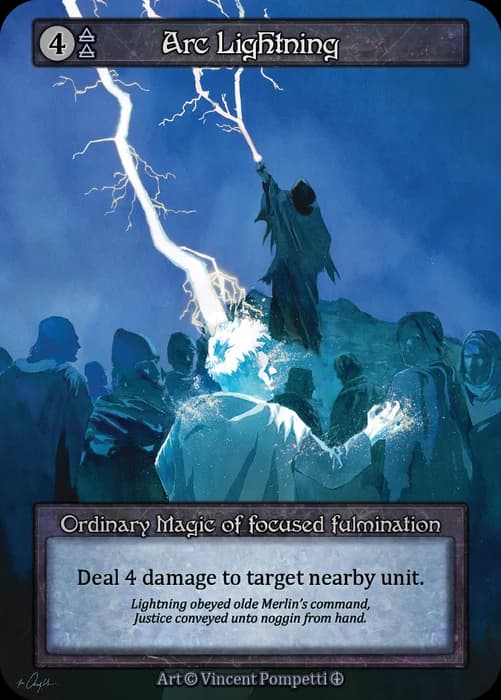
To cast a magic spell, you must declare all targets of the magic. For example, if you cast Arc Lightning, you must declare the "target nearby unit" at the moment you cast the magic spell. When the magic goes on the storyline, the target will have been chosen and can't change later when the magic resolves. Note that some magic spells do not use the word "target" and instead use a word like "ally." For example, when you cast Overpower, you do not need to specify which ally you will choose, and instead you simply select the ally when the spell is resolving from the storyline. Finally, there are a few magic spells that don't target directly, and instead cause an ally to target. In that case, you also do not need to specify targets when you cast, since you only need to declare the targets that the magic itself is targeting. For example, if you cast Joust!, you do not need to declare the target when you cast the magic; you select the ally when the magic is resolving from the storyline, and then the ally (not the magic!) does the targeting at that time.Para conjurar um feitiço de magia, você deve declarar todos os alvos da magia. Por exemplo, se você conjura Arc Lightning, deve declarar a "unidade próxima alvo" no momento em que conjura o feitiço de magia. Quando a magia vai para o enredo, o alvo já terá sido escolhido e não pode mudar depois, quando a magia resolver. Note que alguns feitiços de magia não usam a palavra "alvo" e em vez disso usam uma palavra como "aliado". Por exemplo, quando você conjura Overpower, não precisa especificar qual aliado escolherá; em vez disso, você simplesmente seleciona o aliado quando o feitiço está resolvendo do enredo. Por fim, há alguns feitiços de magia que não escolhem alvo diretamente e, em vez disso, fazem um aliado escolher o alvo. Nesse caso, você também não precisa especificar alvos ao conjurar, já que só precisa declarar os alvos que a própria magia está escolhendo. Por exemplo, se você conjura Joust!, não precisa declarar o alvo ao conjurar a magia; você seleciona o aliado quando a magia está resolvendo do enredo, e então o aliado (não a magia!) faz a escolha de alvo naquele momento.