Oversized Units
A rule of the game.
Normally, units occupy only one location while in the realm. However, some oversized units occupy multiple locations simultaneously due to their size, e.g. Mountain Giant. To represent the minion’s locations, place the card at the intersection of the sites. ))Casting(( an ))Oversized Unit(( When you cast such a minion, declare the area it will occupy when summoned, which must include at least one of your sites, per normal minion casting rules. It may include some of your opponent’s sites, but couldn’t include the void (without Voidwalk) nor Gnome Hollows (unless its power was low enough). Determining Size and Occupying Locations A card's size is determined as it enters the realm (or via other effects, e.g. Megamoeba or The Rack) and becomes one of its characteristics. Therefore, even if a Mountain Giant were disabled or in a Silence aura, it would continue to occupy a 2x2 area. Oversized units occupy each of their locations. Therefore, if grid damage is dealt to multiple such locations, oversized units take damage at each of those locations. For example, a Major Explosion centered on a Mountain Giant would deal 7 + 5 + 5 + 3 = 20 damage to it. An oversized unit could simultaneously occupy both land and water sites, as well as void squares if it had voidwalk. It cannot occupy the surface and subsurface simultaneously, unless it has specific text allowing it, e.g. Megamoeba. ))Moving(( When an oversized unit moves, you choose a direction and all parts of it move that direction. If any part of it cannot move in the chosen direction, then it cannot move in that direction at all. All parts of this movement are considered its movement path. - For example: If you cast Whirling Blades on an animated Drought aura, it can move two steps and then will strike enemies at any of the 8 locations it occupied, since all 8 locations are part of its movement path. (If it moved forward and back, then only 6 locations would be part of its movement path.) When moving, an oversized unit only "((enters))" locations it did not occupy before taking each step. ))Attacking(( When attacking, oversized units must target a single enemy unit or site surface that shares a location with it. - For example, a Mountain Giant occupying sites in the squares marked with "M" is attacking. It must choose an enemy unit or site surface in one of those locations. The attack is then happening at that location, and defenders must reach that specific location to defend. ))Nearby(( and ))Adjacent(( When determining if a card is near or adjacent to an oversized unit, you check to see if it is near or adjacent to any location the oversized unit occupies. For instance, the following locations marked "a" are adjacent to the Mountain Giant, marked "M": As a further example, the locations marked "n" are nearby an oversized avatar, marked "A," that has been stretched into an L-shape by The Rack: In the ))above(( diagrams, the locations occupied by the oversized unit are also nearby/adjacent to the unit. For more detailed and specific rulings, see the subcodex entries below:Normalmente, as unidades ocupam apenas uma localização enquanto estão no reino. Porém, algumas unidades superdimensionadas ocupam várias localizações simultaneamente por causa de seu tamanho, por exemplo Mountain Giant. Para representar as localizações do lacaio, coloque a carta na intersecção dos locais. ))Conjurando(( uma ))Unidade Superdimensionada(( Quando você conjura um lacaio desses, declare a área que ele ocupará ao ser invocado, que deve incluir pelo menos um dos seus locais, conforme as regras normais de conjuração de lacaios. Ela pode incluir alguns dos locais do seu oponente, mas não poderia incluir o vazio (sem Caminhar no Vazio) nem Gnome Hollows (a menos que seu poder fosse baixo o bastante). Determinando Tamanho e Localizações Ocupadas O tamanho de uma carta é determinado quando ela entra no reino (ou por outros efeitos, por exemplo Megamoeba ou The Rack) e se torna uma de suas características. Portanto, mesmo que um Mountain Giant estivesse desabilitado ou dentro de uma aura de Silence, ele continuaria ocupando uma área 2x2. Unidades superdimensionadas ocupam cada uma de suas localizações. Portanto, se dano de grade for causado a várias dessas localizações, unidades superdimensionadas recebem dano em cada uma dessas localizações. Por exemplo, uma Major Explosion centrada em um Mountain Giant causaria 7 + 5 + 5 + 3 = 20 de dano a ele. Uma unidade superdimensionada poderia ocupar simultaneamente locais de terreno e de água, além de quadrados de vazio, se tivesse Caminhar no Vazio. Ela não pode ocupar a superfície e a subsuperfície simultaneamente, a menos que tenha texto específico permitindo isso, por exemplo Megamoeba. ))Movendo(( Quando uma unidade superdimensionada se move, você escolhe uma direção e todas as partes dela se movem naquela direção. Se qualquer parte dela não puder se mover na direção escolhida, então ela não pode se mover naquela direção de jeito nenhum. Todas as partes desse movimento são consideradas seu caminho de movimento. - Por exemplo: se você conjurar Whirling Blades em uma aura de Drought animada, ela pode dar dois passos e então golpeará inimigos em qualquer uma das 8 localizações que ocupou, já que todas as 8 localizações fazem parte de seu caminho de movimento. (Se ela tivesse ido e voltado, então apenas 6 localizações fariam parte de seu caminho de movimento.) Ao se mover, uma unidade superdimensionada só "((enters))" localizações que não ocupava antes de dar cada passo. ))Atacando(( Ao atacar, unidades superdimensionadas devem escolher como alvo uma única unidade inimiga ou superfície de local que compartilhe uma localização com elas. - Por exemplo, um Mountain Giant ocupando locais nos quadrados marcados com "M" está atacando. Ele deve escolher uma unidade inimiga ou superfície de local em uma dessas localizações. O ataque então acontece naquela localização, e os defensores precisam alcançar aquela localização específica para defender. ))Próximo(( e ))Adjacente(( Ao determinar se uma carta está perto ou adjacente a uma unidade superdimensionada, você verifica se ela está perto ou adjacente a qualquer localização que a unidade superdimensionada ocupa. Por exemplo, as seguintes localizações marcadas com "a" são adjacentes ao Mountain Giant, marcado com "M": Como mais um exemplo, as localizações marcadas com "n" estão próximas de um Avatar superdimensionado, marcado com "A", que foi esticado em formato de L por The Rack: Nos diagramas ))acima((, as localizações ocupadas pela unidade superdimensionada também estão próximas/adjacentes à unidade. Para decisões mais detalhadas e específicas, veja as subentradas do codex abaixo:Unofficial translation
Burrowing or Submerging Oversized Units
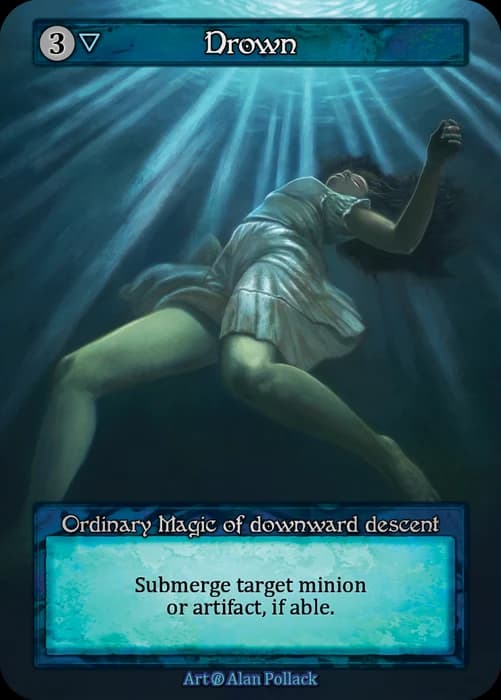
Since an oversized unit occupies more than one location, it cannot burrow or submerge itself when it occupies both a land site and a water site unless it has both the Submerge and Burrowing ability. When an effect attempts to burrow or submerge an oversized unit by force (e.g. Bury, Drown) the effect will fail unless the oversized unit occupies only one type of site (i.e. either all water sites, or all land sites). - For example, you cast Bury on a Mountain Giant that occupies the surface of three land sites and one water site. The effect will fail, since not all parts of the Giant can be burrowed.Como uma unidade superdimensionada ocupa mais de uma localização, ela não pode se enterrar nem se submergir quando ocupa ao mesmo tempo um local de terreno e um local de água, a menos que tenha tanto a habilidade Submergir quanto a Escavador. Quando um efeito tenta enterrar ou submergir uma unidade superdimensionada à força (por exemplo, Bury, Drown), o efeito falha, a menos que a unidade superdimensionada ocupe apenas um tipo de local (ou seja, ou só locais de água, ou só locais de terreno). - Por exemplo, você conjura Bury em um Mountain Giant que ocupa a superfície de três locais de terreno e um local de água. O efeito falha, já que nem todas as partes do Giant podem ser enterradas.
Oversized Units Carrying Artifacts
When casting an artifact into the hands of an oversized unit, choose one of its locations to conjure the artifact to. It will be held by the oversized unit at that location. When an oversized unit carrying an artifact moves, the artifact stays in the same relative position within the oversized unit. For instance, if you have a Mountain Giant at the locations marked "M" and it is carrying an artifact in the location marked "A", it will stay in that relative location while the Giant moves: Stepping to the right: Then stepping forward: The same rules will apply if an oversized unit is carrying another unit.Ao conjurar um artefato para as mãos de uma unidade superdimensionada, escolha uma das localizações dela para materializar o artefato. Ele será segurado pela unidade superdimensionada naquela localização. Quando uma unidade superdimensionada carregando um artefato se move, o artefato permanece na mesma posição relativa dentro da unidade superdimensionada. Por exemplo, se você tem um Mountain Giant nas localizações marcadas com "M" e ele está carregando um artefato na localização marcada com "A", o artefato ficará naquela localização relativa enquanto o Giant se move: Dando um passo para a direita: Depois, dando um passo adiante: As mesmas regras se aplicam se uma unidade superdimensionada estiver carregando outra unidade.
Traversing Borders
When an oversized unit moves, it does not "traverse" borders that it was straddling before moving. - For example: if there is a Mountain Giant occupying the "M" locations and a Perilous Bridge in square "P", the Mountain Giant can step forward to square 1, because it will not be traversing the border between 2 and P. It could not step back down to P afterward, though, as then it would be crossing that border.Quando uma unidade superdimensionada se move, ela não "atravessa" bordas sobre as quais já estava montada antes de se mover. - Por exemplo: se há um Mountain Giant ocupando as localizações "M" e uma Perilous Bridge no quadrado "P", o Mountain Giant pode dar um passo adiante até o quadrado 1, porque não estará atravessando a borda entre 2 e P. Ele não poderia, porém, dar um passo de volta para baixo até P, pois aí sim estaria cruzando aquela borda.
Teleporting Oversized Units
When an oversized unit is teleported, it must be to locations that are all legal for that unit to occupy. It also must not cross regional boundaries, unless the chosen part changes regions (see next paragraph). If the teleportation effect does not target, the controller of the effect chooses one part of the oversized unit. If the effect does target, choose a part that could be targeted. E.g. if Aethermoeba is partially in the void and partially on the surface and you target it with a teleportation effect, choose a part that’s on the surface. If the destination of the teleportation is a single location, the controller of the teleportation effect chooses the position and orientation of the unit, as long as the destination is included in the locations it ends up occupying. For example, Mountain Giant is chosen as the ally for Blink: As the "nearby location," I choose X. Now, the Mountain Giant can end up in any of these positions: Since the Mountain Giant is a square shape, its orientation doesn't typically matter, but if it were carrying something, it could also be rotated as desired from the teleportation. For a more complicated example, an Avatar has been stretched by The Rack so that it is an asymmetrical shape, and is then chosen as the ally for Blink. The controller decides that the part of the Avatar marked with "x" will be teleporting to the square marked "X": The Avatar can end up in any of the following orientations, given those choices: However, if you choose a different part of the Avatar as the “chosen part,” a whole new set of orientations would be possible.
Cards that Refer to a Unit's Site or Location
There are many cards that assume units occupy only one location or site. These cards will have language which refers to "its site" or "its location," or words to that effect, in the context of a unit. When resolving such effects for oversized units, simply pick a single site or location they occupy. For example, Spin Attack, Leap Attack, and Recall all assume the unit occupies only one location; to resolve them properly, you pick one location the oversized unit occupies.Há muitas cartas que supõem que unidades ocupam apenas uma localização ou local. Essas cartas terão uma redação que se refere a "seu local" ou "sua localização", ou palavras nesse sentido, no contexto de uma unidade. Ao resolver efeitos assim para unidades superdimensionadas, simplesmente escolha um único local ou localização que elas ocupem. Por exemplo, Spin Attack, Leap Attack e Recall todas supõem que a unidade ocupa apenas uma localização; para resolvê-las corretamente, você escolhe uma localização que a unidade superdimensionada ocupa.
Oversized Units Shooting Projectiles
When shooting a projectile, an oversized unit chooses one of its locations and the projectile shoots from there. - For example: If you case Grapple Shot and choose your Mountain Giant, occupying the squares marked with "M/m," for its effect. You must select one location occupied by the Giant to be the origin for the projectile, so you choose the location marked "m." The projectile shoots north and hits the Bosk Troll at "B" and then drags the Giant to its location. The Giant will be dragged over the Vile Imp at "V" and will occupy the four squares at the top of the diagram instead of the four at the bottom.Ao disparar um projétil, uma unidade superdimensionada escolhe uma de suas localizações e o projétil é disparado dali. - Por exemplo: se você conjurar Grapple Shot e escolher seu Mountain Giant, que ocupa os quadrados marcados com "M/m", para o efeito. Você deve selecionar uma localização ocupada pelo Giant para ser a origem do projétil, então escolhe a localização marcada com "m". O projétil dispara para o norte e atinge o Bosk Troll em "B", e então arrasta o Giant até a localização dele. O Giant será arrastado por cima do Vile Imp em "V" e ocupará os quatro quadrados no topo do diagrama em vez dos quatro de baixo.