Range of Motion
A rule of the game.
A unit's range of motion is every location it could reach if it used the Move and Attack basic ability, ignoring all triggered abilities. If a unit can't use the Move and Attack basic ability (e.g. Disabled), then it has no range of motion. When determining which locations the unit can reach (and thus Defend there, or be forced to attack there via The Green Knight, for example), the game looks ahead, considering all ongoing effects (including passive abilities) and ignoring all triggered abilities. Below are some examples to help illuminate these rules. Example 1 An Apprentice Wizard is in square A and the attack is happening in square E. The game foresees that the Apprentice Wizard can't reach square E and thus he can't tap to Defend. Example 2 Same as Example 1, but Magellan Globe is in the realm or Waypoint Portal is in effect. Now, the game notices the ongoing effect and allows the Defend ability. Example 3 The attack's location is Gnome Hollows and a Bosk Troll is at an adjacent site. The game foresee that the Bosk Troll won't be able to move into the Gnome Hollows because that's a passive effect, and thus the Troll can't tap to Defend. Example 4 The attack's location is Bottomless Pit and the Bosk Troll is adjacent. The game will allow the Defend ability, because the Troll can actually move there. Of course, the Bosk Troll will die upon arrival due to Bottomless Pit, but the Defend ability would be allowed. Example 5 The attack is happening at A. I have Rimland Nomads at N. There is a Giant Shark at S, which is a water site. As soon as the Rimland Nomads move toward A to Defend, the Shark will fight them at S via its mandatory triggered ability. There is no way that the Nomads could actually reach A in two steps. Nonetheless, the game will allow the Rimland Nomads to use the Defend ability because when the game looks ahead to see which locations the Nomads can reach, the game ignores all triggered abilities. Example 6 Same as Example 5, but instead of a Shark at S, it's a Bog, having targeted itself. In this case, the game will not allow the Nomads to use the Defend ability, because the game considers all ongoing effects (including the Bog) and foresees that the Nomads can't reach the attack's location. The difference is that Giant Shark is a triggered ability (which is ignored during lookahead) and Bog is an ongoing ability (which is considered during lookahead). Lookahead Summary In summary, if the player can demonstrate a movement path that would reach the attack's location, ignoring all triggered abilities, then the Defend ability is allowed. Explanation If you're reading this deeply into the Codex, you might be wondering why the game ignores triggered abilities for the lookahead. One reason is that there are some cases where the lookahead for triggered abilities yields an unknown outcome. For example, in Example 5, instead of Nomads, if it were a Phantom Steed with a Poisonous Dagger carrying Amazon Warriors, can the Phantom Steed reach A or not? It depends if the Shark chooses to fight the Warriors first or the Steed first. The second reason is that this approach allows the lookahead for mandatory actions like "must attack" (e.g. Mask of Mayhem) to use the same rules, since players' intuition in those cases is to force an attack even into a Shark or Mariner's Curse. Therefore, we consistently ignore triggered abilities when considering a unit's range of motion.O alcance de movimento de uma unidade é toda localização que ela poderia alcançar se usasse a habilidade básica Mover e Atacar, ignorando todas as habilidades disparadas. Se uma unidade não pode usar a habilidade básica Mover e Atacar (por exemplo, por estar Desabilitada), então ela não tem alcance de movimento. Ao determinar quais localizações a unidade pode alcançar (e assim Defender ali, ou ser forçada a atacar ali via The Green Knight, por exemplo), o jogo olha adiante, considerando todos os efeitos contínuos (incluindo habilidades passivas) e ignorando todas as habilidades disparadas. Abaixo estão alguns exemplos para ajudar a esclarecer essas regras. Exemplo 1 Um Apprentice Wizard está no quadrado A e o ataque está acontecendo no quadrado E. O jogo prevê que o Apprentice Wizard não consegue alcançar o quadrado E e, portanto, ele não pode virar para Defender. Exemplo 2 Igual ao Exemplo 1, mas Magellan Globe está no reino ou Waypoint Portal está em efeito. Agora o jogo nota o efeito contínuo e permite a habilidade Defender. Exemplo 3 A localização do ataque é Gnome Hollows e um Bosk Troll está em um local adjacente. O jogo prevê que o Bosk Troll não conseguirá se mover para dentro do Gnome Hollows, porque isso é um efeito passivo, e portanto o Troll não pode virar para Defender. Exemplo 4 A localização do ataque é Bottomless Pit e o Bosk Troll está adjacente. O jogo permitirá a habilidade Defender, porque o Troll de fato consegue se mover até ali. Claro, o Bosk Troll morrerá ao chegar por causa do Bottomless Pit, mas a habilidade Defender seria permitida. Exemplo 5 O ataque está acontecendo em A. Eu tenho Rimland Nomads em N. Há um Giant Shark em S, que é um local de água. Assim que os Rimland Nomads se moverem em direção a A para Defender, o Shark lutará com eles em S por sua habilidade disparada obrigatória. Não há como os Nomads de fato alcançarem A em dois passos. Ainda assim, o jogo permitirá que os Rimland Nomads usem a habilidade Defender, porque, quando o jogo olha adiante para ver quais localizações os Nomads podem alcançar, ele ignora todas as habilidades disparadas. Exemplo 6 Igual ao Exemplo 5, mas em vez de um Shark em S, é um Bog que escolheu a si mesmo como alvo. Nesse caso, o jogo não permitirá que os Nomads usem a habilidade Defender, porque o jogo considera todos os efeitos contínuos (incluindo o Bog) e prevê que os Nomads não conseguem alcançar a localização do ataque. A diferença é que Giant Shark é uma habilidade disparada (que é ignorada na antevisão) e Bog é uma habilidade contínua (que é considerada na antevisão). Resumo da Antevisão Em resumo, se o jogador conseguir demonstrar um caminho de movimento que alcançaria a localização do ataque, ignorando todas as habilidades disparadas, então a habilidade Defender é permitida. Explicação Se você está lendo o Codex a esta profundidade, pode estar se perguntando por que o jogo ignora habilidades disparadas na antevisão. Uma razão é que há casos em que a antevisão de habilidades disparadas produz um resultado desconhecido. Por exemplo, no Exemplo 5, se em vez dos Nomads fosse um Phantom Steed com uma Poisonous Dagger carregando Amazon Warriors, o Phantom Steed consegue alcançar A ou não? Depende de o Shark escolher lutar primeiro com os Warriors ou com o Steed. A segunda razão é que essa abordagem permite que a antevisão de ações obrigatórias como "deve atacar" (por exemplo, Mask of Mayhem) use as mesmas regras, já que a intuição dos jogadores nesses casos é forçar o ataque mesmo contra um Shark ou uma Mariner's Curse. Portanto, ignoramos consistentemente as habilidades disparadas ao considerar o alcance de movimento de uma unidade.Tradução não oficial
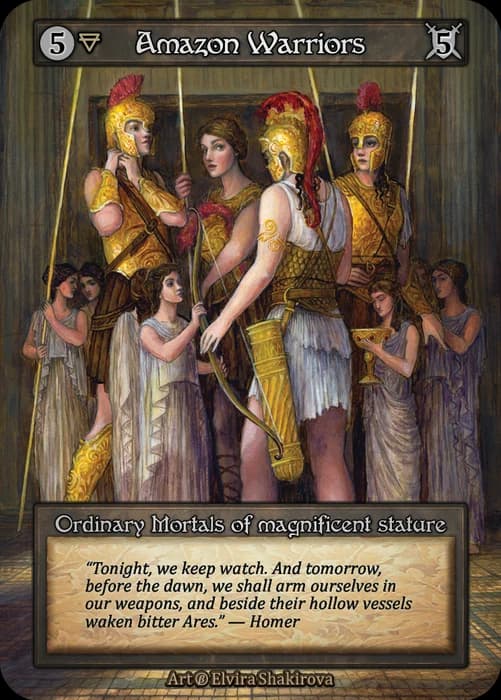
Amazon Warriors
Ordinary

Apprentice Wizard
Ordinary

Bog
Ordinary

Bosk Troll
Ordinary

Bottomless Pit
Elite

Giant Shark
Exceptional

Gnome Hollows
Exceptional

Magellan Globe
Elite

Mariner's Curse
Exceptional

Mask of Mayhem
Elite

Phantom Steed
Exceptional

Poisonous Dagger
Exceptional

Rimland Nomads
Ordinary

The Green Knight
Unique

Waypoint Portal
Exceptional