Transform
A rule of the game.
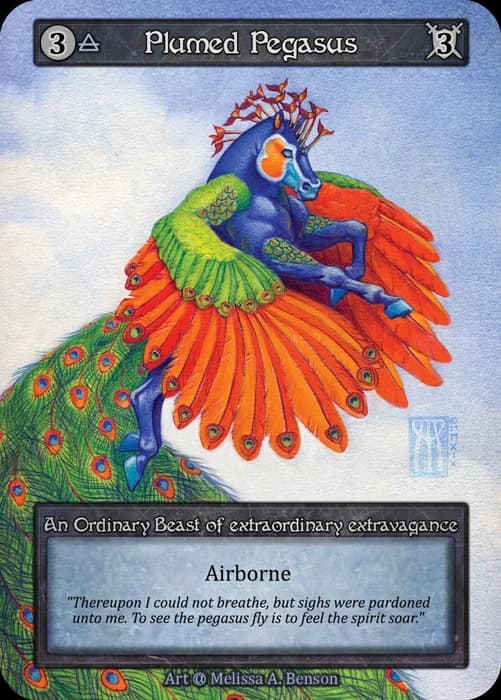
When a card transforms, its printed abilities and characteristics change to match its new form, but it is otherwise the same game object. That means the new form does not "enter the realm" and does not trigger any "enter the realm" effects like Genesis - it was there all along! Furthermore, since the new form doesn't enter the realm, it will not suffer from summoning sickness, assuming the old form didn't enter the realm this turn. If one card transforms into a different card, the original card is banished but game effects treat it as the same game object. For example, if you play Pollimorph on my Apprentice Wizard, I end up with a Frog token under my control and the Apprentice Wizard card is banished. If some game effect was tracking the Apprentice Wizard, it is now tracking the Frog token. If one card transforms into a different type, e.g. Island Leviathan, continue to use the same card. When a card transforms, it does not die and deathrites do not trigger. For example, if you Pollimorph my Kettletop Leprechaun into a Frog token, I do not resolve the Leprechaun's deathrite. When a card transform, control of the card does not change unless specified by card text. For example, if I use Descrate on your site, you still will control the new Desecrated Ground. If you summon Mimic to transform one of my artifacts, you will still control your Mimic because of Mimic's specific text, "under your control." As mentioned above, the printed abilities and characteristics change to match the new form upon transformation. For example, if a Plumed Pegasus is Shapeshifted into Great Old One, it no longer has Airborne or 3 power, and its Genesis does not trigger. Instead, it has Submerge and 16 power. In contrast, any ongoing effects continue to apply to the new form! For example, if I cast Power of Flight on my Bosk Troll and then I Shapeshift it into Great Old One, it does have Airborne until my next turn, since Power of Flight applies to the game object and isn't a printed ability. The game treats the new form as the same game object. For example, if the old form was tapped, had taken damage, and was carrying an artifact, the new form will also be tapped, have damage, and will be carrying that artifact. Note that Stealth and Ward, though a printed keyword on many cards, are tracked via a Stealth mark and a Ward mark, respectively. Therefore, Stealth and Ward marks will carry over to the new form. For example, if I Shapeshift a Band of Thieves with a Stealth mark into a Great Old One, it will still have the Stealth mark. If I cast Fade on my Bosk Troll and then Shapeshift it into Great Old One, then it will also still have the Stealth mark. Unlike the Airborne example, Stealth and Ward are tracked via a mark, which carries over. Finally, if you Shapeshift a minion into a new form with the printed Stealth or Ward keyword, Stealth and Ward will not trigger since they are an "enters the realm" effect. You only get the Stealth mark or Ward mark when the minion enters the realm, and it's not entering the realm when transforming.Quando uma carta se transforma, suas habilidades e características impressas mudam para corresponder à sua nova forma, mas ela é, fora isso, o mesmo objeto de jogo. Isso significa que a nova forma não "entra no reino" e não dispara nenhum efeito de "entra no reino", como Gênese — ela esteve ali o tempo todo! Além disso, como a nova forma não entra no reino, ela não sofrerá de enjoo de invocação, supondo que a forma antiga não tenha entrado no reino neste turno. Se uma carta se transforma em uma carta diferente, a carta original é banida, mas os efeitos de jogo a tratam como o mesmo objeto de jogo. Por exemplo, se você jogar Pollimorph no meu Apprentice Wizard, eu acabo com uma ficha de Sapo sob meu controle e a carta Apprentice Wizard é banida. Se algum efeito de jogo estava acompanhando o Apprentice Wizard, agora ele acompanha a ficha de Sapo. Se uma carta se transforma em um tipo diferente, por exemplo Island Leviathan, continue usando a mesma carta. Quando uma carta se transforma, ela não morre e ritos mortais não disparam. Por exemplo, se você usar Pollimorph no meu Kettletop Leprechaun transformando-o em uma ficha de Sapo, eu não resolvo o rito mortal do Leprechaun. Quando uma carta se transforma, o controle da carta não muda, a menos que o texto da carta especifique. Por exemplo, se eu usar Descrate no seu local, você ainda controlará o novo Desecrated Ground. Se você invocar Mimic para transformar um dos meus artefatos, você ainda controlará seu Mimic por causa do texto específico do Mimic, "sob seu controle". Como dito acima, as habilidades e características impressas mudam para corresponder à nova forma na transformação. Por exemplo, se um Plumed Pegasus for transformado por Shapeshift em um Great Old One, ele deixa de ter Aéreo e 3 de poder, e sua Gênese não dispara. Em vez disso, ele tem Submergir e 16 de poder. Em contraste, quaisquer efeitos contínuos continuam a se aplicar à nova forma! Por exemplo, se eu conjurar Power of Flight no meu Bosk Troll e então usar Shapeshift para transformá-lo em um Great Old One, ele tem sim Aéreo até o meu próximo turno, já que Power of Flight se aplica ao objeto de jogo e não é uma habilidade impressa. O jogo trata a nova forma como o mesmo objeto de jogo. Por exemplo, se a forma antiga estava virada, tinha recebido dano e carregava um artefato, a nova forma também estará virada, terá dano e estará carregando aquele artefato. Note que Furtividade e Proteção, embora sejam palavras-chave impressas em muitas cartas, são acompanhadas por um marcador de Furtividade e um marcador de Proteção, respectivamente. Portanto, os marcadores de Furtividade e Proteção passam para a nova forma. Por exemplo, se eu usar Shapeshift em um Band of Thieves com marcador de Furtividade, transformando-o em um Great Old One, ele ainda terá o marcador de Furtividade. Se eu conjurar Fade no meu Bosk Troll e então usar Shapeshift para transformá-lo em um Great Old One, ele também ainda terá o marcador de Furtividade. Ao contrário do exemplo do Aéreo, Furtividade e Proteção são acompanhadas por um marcador, que passa adiante. Por fim, se você usar Shapeshift para transformar um lacaio em uma nova forma com a palavra-chave impressa Furtividade ou Proteção, Furtividade e Proteção não dispararão, já que são um efeito de "entra no reino". Você só ganha o marcador de Furtividade ou de Proteção quando o lacaio entra no reino, e ele não está entrando no reino ao se transformar.Tradução não oficial




Descrate